
By Hernan Lopez.
Companies mentioned: Alphabet, Amazon, Apple, AppLovin, Bytedance, Comcast, Disney, Electronic Arts, Meta, Microsoft, Netflix, Nintendo, Paramount Skydance, Roblox, Samsung, Sony, Spotify, Take-Two Interactive, Tencent, Universal Music Group, Walmart, Warner Bros. Discovery.
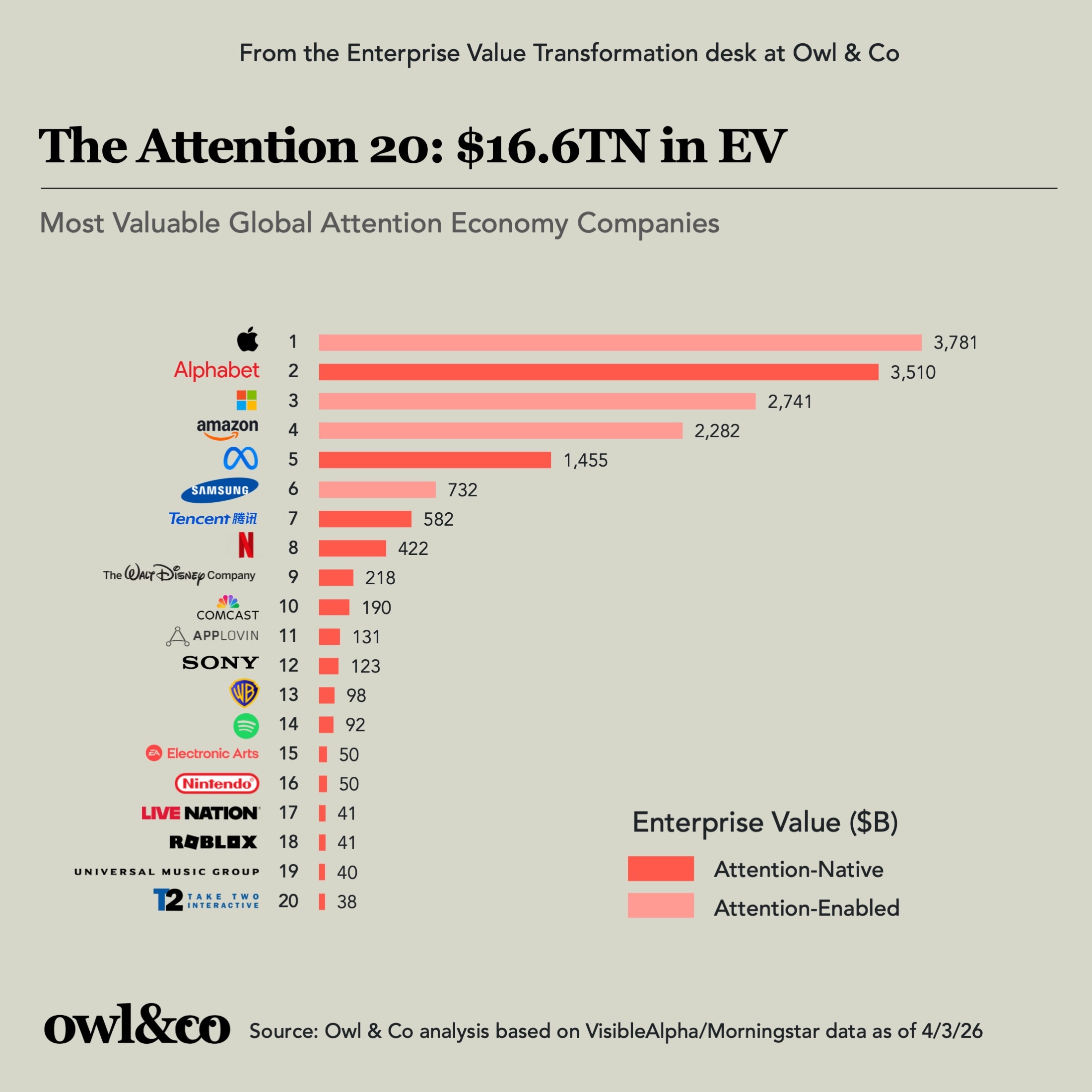
Questions answered: Which companies made Owl & Co’s Attention 20, the 20 top global attention economy companies ranked by enterprise value? What’s more closely correlated with EV/Sales: Growth or Margins? How can Netflix add billions of engagement hours without lifting a finger?
Special note: This is a public version of the Streamonomics® newsletter. I send an exclusive version to Owl & Co clients one day in advance, which includes more in-depth analysis, access to Owl & Co proprietary research, and additional charts. If you work for an Owl & Co client (or would like to become one), just hit reply.
Streamonomics readers know the attention economy. Herbert Simon first proposed the concept in 1971. I encountered it through Tom Davenport’s 2001 book of the same name. The core argument: Companies that capture consumers’ attention and monetize well can build lasting enterprise value. Mary Meeker, Michael Wolf, and Rich Greenfield are top of mind among the thinkers who made this connection explicit: Mary Meeker’s early aughts charts comparing the share of time spent to the share of ad revenue, with newspapers overmonetized and the internet undermonetized, turned out to be one of the cleanest predictive signals of the decade.
But the relationship between time spent and enterprise value is neither direct nor stable...